We're going to do something unusual: tell you honestly when the other products are better. Knowing what a tool is actually for — and what it isn't — is more useful than a one-sided comparison. So here's our best reading of where each product wins.
What RagmyAI is built for
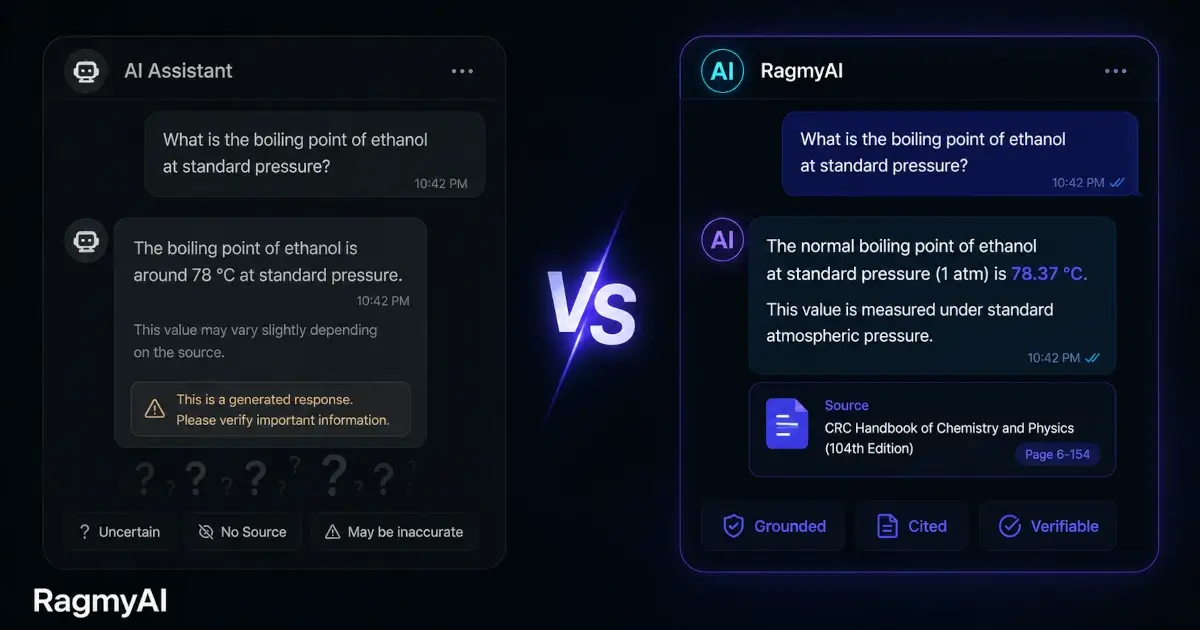
RagmyAI is a personal AI builder. It's designed for the use case where you have your own documents, your own data, and you want an AI that answers from those — not from the open internet. You train it. You embed it. You retrain it when it's wrong.
ChatGPT, Claude, and Gemini are general-purpose assistants. They're built to answer almost anything from their training data — which is vast, recent, and impressive. They're not built to answer from your Q3 report, your product manual, or your lecture slides.
That's the core distinction. Everything else follows from it.
Where RagmyAI wins
Answers grounded in your documents
If you upload your 80-page employee handbook and ask "What is the policy on carrying over unused leave?", RagmyAI will answer from the handbook, not invent a policy that sounds plausible. ChatGPT, Claude, and Gemini will give you a generic answer based on typical HR practices — unless you paste the entire document into the conversation every time, which is impractical and wastes context.
Embeddable, shareable chatbot
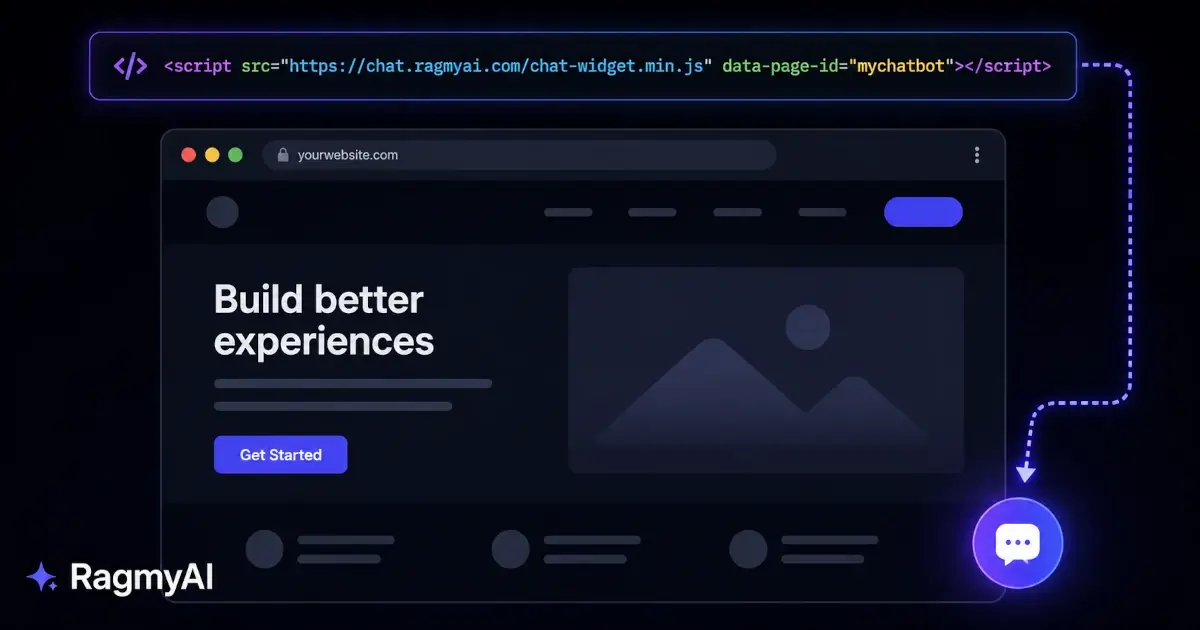
None of the general assistants let you publish your trained chatbot as a widget on your website with one line of code. RagmyAI does. This is the feature that makes it useful for small businesses, educators, and anyone who wants to give other people access to an AI trained on specific content.
Voice cloning and 3D avatar
This is unique to RagmyAI. You can clone your voice in 60 seconds and have the AI speak back in it, in 78 languages. No other product in this tier offers this.
Free image generation with no quota
ChatGPT's image generation is rate-limited and requires a paid plan. RagmyAI includes unlimited image generation on the free plan.
Where ChatGPT wins
General knowledge depth
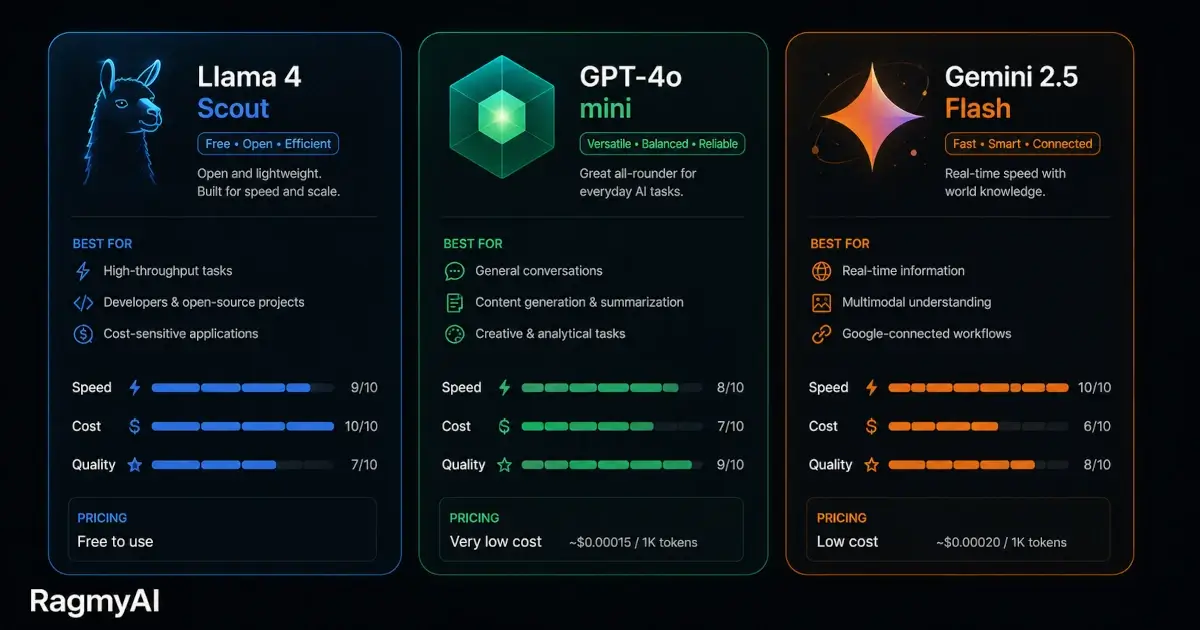
OpenAI's models have been trained on an enormous breadth of data with careful reinforcement learning. For questions that don't require your specific documents — "explain the French Revolution," "write a cover letter," "debug this Python function" — GPT-4o gives better answers than Llama 4 Scout (RagmyAI's free default model) on most benchmarks.
Code generation
GPT-4o and Claude Sonnet are significantly better at generating and debugging code. If programming assistance is your primary use case, they're the right tool.
Plugin and integration ecosystem
ChatGPT has a large ecosystem of plugins and integrations. If you need to connect to third-party services, the options are broader.
Where Claude wins
Long-form reasoning and writing
Anthropic's Claude is widely regarded as producing the most nuanced, well-structured long-form writing and analysis among the major models. For research synthesis, complex argumentation, or editing lengthy documents, Claude Sonnet is hard to beat.
Safety and refusal calibration
Claude is more carefully calibrated to decline harmful requests without being trigger-happy about it — useful in enterprise settings where output consistency matters.
Where Gemini wins
Google Workspace integration
If your workflow lives in Google Docs, Sheets, and Gmail, Gemini's native integration is genuinely useful. RagmyAI doesn't connect to Google Workspace.
Multimodal understanding
Gemini 2.5 Pro has strong performance on tasks that mix text, image, and video understanding — useful for media-heavy workflows.
The honest summary
If you want a general assistant that can do anything: use ChatGPT or Claude. They're better at general tasks.
If you want an AI that answers from your specific documents, speaks in your voice, and can be embedded on your website: RagmyAI is built for that, and none of the general assistants are.
Most people who use RagmyAI use a general assistant too — for different jobs. They're not in competition for the same task.